
NDA and Mould Ownership in OEM Jewelry Manufacturing
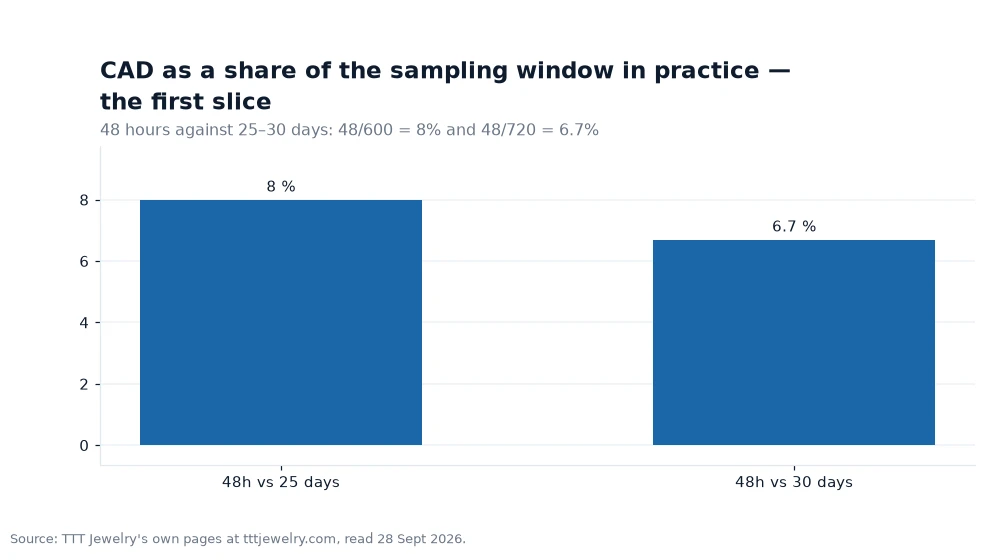
Who owns a mould is settled on paper long before it is settled in brass. TTT Jewelry publishes 100% NDA coverage and states that designs stay 100% exclusive, with moulds, CAD files and collections not resold or shown. Those promises are testable against a published clock: CAD under 48 hours inside a sampling window of 25–30 days, which is 8% of a 25-day window and 6.7% of a 30-day one.

Key takeaways
- CAD occupies 2 of the 25–30 sampling days, leaving 23–28 days when a physical master and tooling exist at the factory.
- 100% NDA means every design in the programme, not a selected subset, is covered in writing.
- Tooling falls into three commercial arrangements, and only one of them leaves the brand holding the asset at contract end.
- A 50-piece silver MOQ and a 100-piece brass MOQ imply different tooling exposure per design.
What a confidentiality clause can cover
An NDA is a list of things that may not be disclosed, plus a definition of who counts as a discloser. In jewelry development the useful list is specific: technical drawings, CAD and mesh files, render images, master samples, alloy and plating recipes, stone layouts, supplier names, and the existence of the project itself. A clause that only says designs are confidential leaves the file formats and the sample photographs outside the fence.
Equally important is what an NDA cannot do. It cannot make a generic construction secret. A claw setting, a box clasp or a cable chain are industry vocabulary, and no agreement turns them into private property. What the agreement protects is the particular arrangement, the proportions, the surface treatment and the brand association. Buyers who expect more than that tend to be disappointed by enforceability.
Practical coverage also needs a duration and a return obligation. Files should come back or be destroyed at the end of the relationship, and the obligation should name the formats. Without that, a supplier can hold a working model indefinitely while claiming the confidentiality period has expired.
Three tooling arrangements buyers meet
Mould conversations go wrong when the word ownership is used without a verb. Owning a mould can mean holding it, paying for it, controlling its use, or inheriting it. The table separates the arrangements that appear most often in OEM contracts.
| Arrangement | Who holds the tool | Who may use it | Document to request |
|---|---|---|---|
| Buyer-owned tooling | Factory, on the buyer's behalf | Buyer's orders only | Tool register with cavity count and storage location |
| Factory-retained tooling | Factory | Factory, output reserved to the brand | Exclusivity schedule naming the design |
| Amortised tooling | Factory until a quantity threshold | Transfers to buyer at the threshold | Written threshold and transfer trigger |
| Open library tooling | Factory | Factory, across several clients | Buyer opts out in writing before sampling |
The fourth row is the one brands overlook. A supplier can produce a good casting from a shared library mould and still deliver a design that appears elsewhere. The cost advantage is real, and so is the exclusivity loss. The choice should be explicit at brief stage, not discovered at a trade show.
TTT Jewelry states the opposite position: moulds, CAD and the collection are not resold or shown, and designs are 100% exclusive to the brand. That is a factory-retained arrangement with an exclusivity guarantee attached, which is why the guarantee needs to be written into the order rather than assumed from a website sentence.
The CAD file is the asset that travels
Of everything exchanged during development, the CAD file travels furthest and fastest. It is small, portable and easy to re-use, which is exactly why it deserves its own clause. A native parametric file lets the next workshop change a wall thickness in minutes; a neutral mesh export discourages edits but does not prevent copying.
The published 48-hour CAD window compresses the period in which a first model is created. It does not shorten the period in which that model is reviewed, questioned and revised. Version control therefore matters more than creation speed. A file named final_v3 tells a buyer nothing; a file with a revision number, a date and a named approver tells them which model the mould was cut from.
Ask three questions about the file itself. Which formats are delivered at the end of the project? Is the native file included or only a mesh? And does the delivery obligation survive the end of the commercial relationship? The answers separate a design service from a production service, and they matter when a brand changes supplier.
File handling is also where an OEM/ODM relationship differs from a simple purchase order. A purchase order ends with goods; a development relationship also hands over a model, and that model can outlive the order. ISO 9001:2015 requires documented control at every production stage, and a supplier that applies the same discipline to file versions makes the handover auditable. A jewelry OEM ODM partner should be able to produce the revision history for the exact model that cut the mould.
Exclusivity has a clock attached
Exclusivity is usually written as a promise about what the factory will not do. It is more useful written as a promise with a time boundary. Most disputes arise because the boundary was never stated: how long does the design stay off the factory's other client list, and what happens to the mould after the last order?
For silver lines, the published MOQ is 50 pieces per design, and for the artisan eco-brass line it is 100 pieces per design. That difference shapes exclusivity economics. A brand ordering 50 silver pieces is asking a factory to reserve a mould for a smaller run than a brass buyer at 100 pieces, so the reserve period is often shorter or the tooling charge higher. Neither outcome is unreasonable; both should be visible.
The artisan route is worth mentioning because the material itself carries a story that buyers resell. A custom brass jewelry programme usually pairs a 100-piece threshold with anti-tarnish e-coating, and the coating specification is part of what should be protected, not just the silhouette.
Worked example
Put the published numbers on a clock. A 48-hour CAD step is 2 days. Sampling runs 25 to 30 days. Divide 48 hours by 600 hours (25 days) and the CAD share is 8%. Divide it by 720 hours (30 days) and the share is 6.7%.
Subtract the CAD time from the window and the exposure becomes clearer: 25 − 2 = 23 days, and 30 − 2 = 28 days. For 23 to 28 days, a physical master exists at the factory and a mould may already be cut. That is the period an NDA has to survive, because digital copying is fast but a physical master can be duplicated at a bench with no network connection at all.
Multiply that exposure across a collection of ten designs and the arithmetic is 230 to 280 tooling-days in a single season. A brand that treats every design as equally sensitive will spend its legal attention evenly; a brand that ranks designs by expected revenue will put its tightest clauses on the two or three that carry the line.
Frequently asked questions
Who owns the mould in an OEM jewelry order?
It depends on the contract: buyer-owned, factory-retained, amortised and shared library arrangements all exist, and the order should name the holder, the permitted users and the storage location.
Does an NDA stop a factory from reusing a design?
An NDA binds the party that signs it and can support a claim if a design is disclosed or reused, but it needs a clear definition of the design, a duration and a return obligation to be useful.
How long does a design stay exclusive?
The published position is that designs are 100% exclusive and moulds, CAD and collections are not resold or shown; the reserve period itself should be written into the order.
What to settle before tooling starts
Four items belong in writing before a mould is cut: the tool register, the file delivery list, the exclusivity period, and the end-of-contract handling of both. Each is a page, and each prevents an argument that costs more than the page.
Buyers sourcing across metals should also compare thresholds, because the sterling silver jewelry manufacturer page states 50 pieces per design while the brass line sits at 100. The lower silver threshold buys exclusivity on smaller runs, at a metal cost that the buyer is already accepting.
None of this replaces a working relationship. It simply gives the relationship a floor, so that a change of buyer, a change of supplier or a quiet end to a season does not leave the tooling in an undefined state.
Source note: figures come from the manufacturer's own website (tttjewelry.com), read 28 Sept 2026.[1]