
A Reference Work for World History
Export Shipping and Customs Mistakes for a Subscription Fragrance Brand
A subscription model turns export paperwork from a project into a rhythm, and every mistake is repeated on the next dispatch. The expensive errors are rarely exotic: a classification that suits the perfume but not the pack, a document set that was never checked against the destination rules, or a shipping plan built as if fragrance were an ordinary cosmetic. Fixing these before the first dispatch costs a week; discovering them in month three costs a subscriber list.
Key takeaways
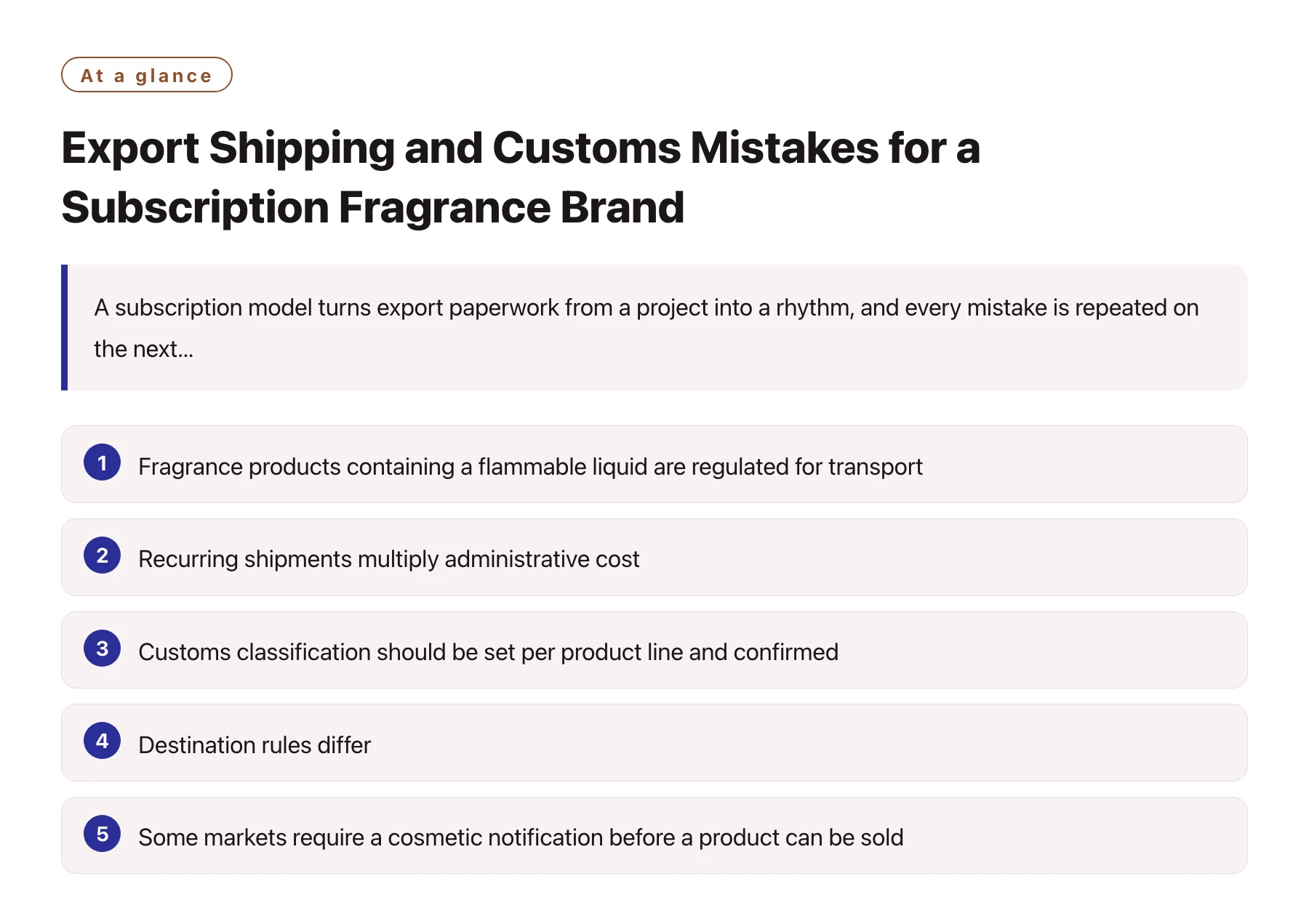
- Fragrance products containing a flammable liquid are regulated for transport, so the carrier's acceptance rules and the required documentation belong in the launch plan, not in the freight quote.
- Recurring shipments multiply administrative cost, so a subscription brand should compare the total cost of many small dispatches against fewer consolidated ones.
- Customs classification should be set per product line and confirmed, because a wrong code produces duty errors and delays that repeat on every order.
- Destination rules differ, and the obligations often attach to the party placing the product on that market rather than to the factory that made it [1].
- Some markets require a cosmetic notification before a product can be sold, so the notification should be scheduled alongside the artwork rather than after the listing [2].
Subscription fragrance brands usually discover logistics after the product exists. The first dispatch is treated as a test, the second as a repeat, and by the third the process has hardened whether or not it is correct.
The mistakes below are ordered by how much they cost once they become routine. Each one is cheaper to fix before dispatch than after, and the table at the end collects the fixes in one place.
Mistake one: treating perfume as ordinary cosmetic freight
A fragrance built on an alcohol carrier is classified as dangerous goods for transport, which changes what carriers will accept, how the goods must be packed, and what paperwork travels with the consignment. Air and sea freight have different acceptance rules, and the limited-quantity provisions that make small parcels practical do not apply uniformly across modes or carriers.
The practical consequence for a subscription brand is that the shipping method may drive the pack design. A format acceptable as a limited quantity by one route may need different outer packaging for another, and that decision has to be made before tooling rather than after the first carrier refuses a pallet.
It is also worth reading how chemicals and hazardous substances are managed internationally, because the transport rules sit inside a wider regulatory picture that keeps moving [3]. A supplier that treats the dangerous goods declaration as a form to fill in has usually not looked at it recently.
Mistake two: designing a shipping rhythm around inventory rather than paperwork
Monthly fulfilment feels operationally clean and administratively expensive. Each dispatch carries its own set of declarations, its own clearance, and often its own fixed handling cost, and those costs do not fall proportionally with the size of the shipment. A brand shipping four small consignments a month can pay more in fixed costs than one shipping a single consolidated consignment of the same annual volume.
That does not automatically mean consolidating, because consolidation changes the inventory position and the customer promise. It means modelling the administrative cost per dispatch before choosing the rhythm, so the subscription price reflects the logistics rather than discovering the gap at the end of the first quarter.
The same arithmetic applies to the manufacturing side. Small frequent runs put pressure on changeover and inspection time, which is why the production question and the shipping question should be settled together. Material on production capacity and lead times is a useful reference for what a factory can hold to at a monthly cadence, as opposed to an annual volume.
Mistake three: leaving classification and documents to the freight forwarder
Forwarders are good at moving goods and not responsible for what the goods are. The classification of a fragrance, the description on the commercial invoice, and the declared value are the brand's statements, and a forwarder that fills them in from a template is guessing on the brand's behalf.
The damage is cumulative. A classification error that clears once will be repeated on every dispatch until an authority notices, and the correction can involve retrospective duty, penalties and a hold on stock that subscribers are already expecting.
The fix is unglamorous: fix the classification per product line, document it with the reasoning, and check the invoice description against the actual product rather than against the previous shipment.
Mistake four: assuming the destination obligations are the factory's problem
Most subscription brands start by asking the factory to handle everything. The factory can handle manufacturing and often the export side, but the obligations that attach to placing a product on a specific market usually belong to the brand or to a nominated representative in that market.
In the European Union, for example, a cosmetic product needs a responsible party established in the Union, and the documentation that supports the product has to be available. That is a commercial arrangement the brand has to make, not a document the factory can generate [1].
Other markets add notification requirements, label language rules or specific restrictions. Canada, for instance, requires cosmetic products to be notified before they are sold, with the notification filed by the party placing the product on the market [2]. None of this is difficult when it is planned; all of it becomes difficult when a first subscriber order is already paid for and the stock is stuck.
Mistake five: forgetting that refills change the customs story
A refill sent to an existing subscriber may look like a spare part to the brand and like a separate cosmetic product to a customs authority. Whether it is declared separately, whether duty applies again, and whether the destination market treats it as a new product all depend on rules the brand has to check rather than assume.
There is also an inventory effect. If refills ship separately from packs, the number of dispatches per subscriber doubles without doubling revenue, which is exactly the kind of detail that makes a subscription model unprofitable at scale while looking healthy in a spreadsheet.
The recurring mistakes and their fixes
| Mistake | Why it hurts | What to do instead |
|---|---|---|
| Treating fragrance as ordinary freight | Carrier refusal, held consignments, missed subscriber dates | Confirm the transport classification and documentation per mode before tooling |
| Splitting shipments without costing them | Fixed clearance and handling costs repeat on every dispatch | Model administrative cost per dispatch when choosing the fulfilment rhythm |
| Letting a forwarder classify the product | The same error repeats on every order and compounds duty exposure | Fix the classification per line and keep the reasoning on file |
| Assuming the factory owns market obligations | Listing blocked at the destination with stock already committed | Identify who represents the product in each market and appoint them early |
| Ignoring refill treatment | Double duty or double administration on the same subscriber | Check how refills are classified in each destination before launch |
| Leaving labelling language to artwork | Rejected or relabelled stock at the border | Include destination label text in the artwork brief before sampling ends |
Three of these six are commercial arrangements rather than manufacturing ones, which is why they are the ones factories are least able to fix for a brand.
Sequencing the work
The order that works is: decide the product and the pack, confirm the transport classification, choose the destination markets, appoint whoever represents the product in each of them, then build the artwork to include the destination label text. Freight quotes come last, and they come with the classification and the packing method already fixed.
Companies that reverse that order end up reworking the pack after the artwork is signed, which is the most expensive place to make a change. A manufacturer's published scope is a reasonable place to check what is covered on the production side and what is not; More information about a supplier's service boundary is more useful than a general capability statement, because it tells the brand where its own work starts.
It also helps to know what a contract manufacturer will and will not take on. Where the arrangement is contract perfume manufacturing in China, the factory usually owns compounding, filling, packing and export documentation, and the brand owns market registration, destination representation and the commercial terms of carriage. Writing that split down before the first dispatch prevents the most common argument in the third month of a subscription.
Before dispatch one, walk a single consignment through the whole chain on paper: classification, packing, documents, clearance, delivery. Every step that has no named owner is a step that will fail on a busier week.
Sources
- European Commission: Cosmetics in the EU —— The European Commission's overview of EU cosmetics rules, including the responsible person, product information file and safety report requirements.
- Health Canada: Cosmetic Safety —— Health Canada's cosmetics pages, covering cosmetic notification, the ingredient hotlist and safety requirements for cosmetics sold in Canada.
- UNEP: Chemicals and Pollution Action —— The UN Environment Programme's pages on chemicals management, including the sound management of chemicals in products.
Frequently asked questions
Can perfume be shipped by air?
Often yes, but it is regulated as dangerous goods and must meet the carrier's packing, quantity and documentation requirements. Confirm acceptance with the specific carrier and route before promising delivery dates.
Does every destination need its own registration?
Requirements vary. Some markets require a notification or a locally established responsible party before sale, and others simply require compliant labelling. Check each target market rather than assuming one approach works everywhere.
Who is responsible if customs rejects a shipment?
Usually the party that made the declaration, which in most subscription arrangements is the brand. The forwarder can correct a filing, but it cannot take on the legal responsibility for it.
Should refills ship with the main pack?
That depends on the cost of the extra dispatch against the inventory and cash-flow benefit. Model both, and check how the destination treats the refill before deciding.
How far in advance should export paperwork start?
Before artwork is signed. Destination label text and classification decisions both feed into artwork, and changing them afterwards is the most expensive revision a launch can make.